-
- According to Transparency Market Research’s latest report on the global cardiac Pacemakers market for the historical period 2017–2018 and forecast period 2019–2027, increase in incidence of cardiovascular diseases, and rise in geriatric population are projected to drive the global cardiac Pacemakers market during the forecast period
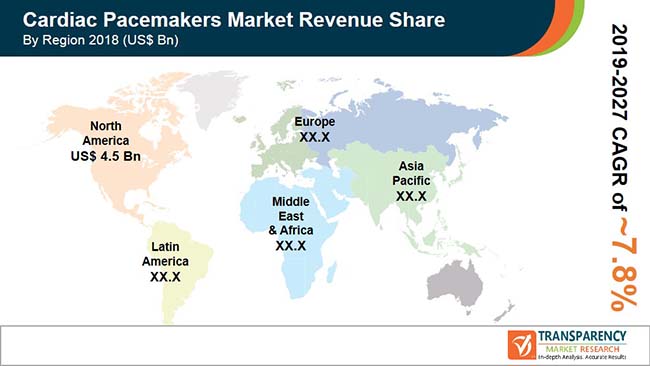
- According to the report, the global cardiac Pacemakers market was valued at US$ 9,514.0 Mn in 2018 and is anticipated to expand at a CAGR of 7.8% from 2019 to 2027
Request the Coronavirus Impact Analysis on this Markets - https://www.transparencymarketresearch.com/sample/sample.php?flag=covid19&rep_id=46407
To know the scope of our report Get a Sample on Cardiac Pacemakers Market
Increasing demand for minimally-invasive procedures to Promote Usage of Cardiac Pacemakers: Key Drivers
- Minimally invasive procedures include reduced stay in the hospital, limited incision, fewer pain following surgery and faster healing period. Such advantages draw doctors and thereby increase the number of doctors who opt for minimally invasive surgery. Both procedures ensure the patient experiences minimum pain and distress.
- Globally, minimally-invasive cardiac procedures were around 15 million in 2017, and are estimated to reach 30 million by 2030. These statistics provide an understanding of the rising trend in the number of minimally-invasive surgeries performed globally.
- Rapid changes in technology are expected to further accelerate the number of minimally-invasive surgeries. Thus, a rise in the number of minimally-invasive surgeries is likely to drive the overall cardiac pacemakers market. Hence, this driver would have a high impact on the growth of the cardiac pacemakers market throughout the forecast period.
Get a glimpse of the in-depth analysis through our Report Brochure
Rise in Geriatric Population Boost Market Growth
- Rise in the geriatric population directly affects the growth and development of cardiac pacemaker products. This is primarily due to aged people are highly susceptible to cardiovascular diseases such as sick sinus syndrome and atrio-ventricular blockage.
- Growth in the global base of population over 65 years of age would act as a high impact driver of the market. According to the U.S. Census Board, people older than 65 years represented around 13% of the total population; this percentage is expected to grow at an estimated 20% by 2030. According to the World Health Organization, the global geriatric population is anticipated to reach 1.5 billion by 2050. Other countries aging at a rapid pace are the U.S., Japan, and Germany. The impact of this driver is expected to remain high during the forecast period as the global geriatric population is constantly rising.
- Furthermore, the United Nations Population Division published in 2013 that the global geriatric population is expected to more than double, from 841 million in 2013 to 2 billion by 2050. It also revealed that people aged 80 years and above accounted for 14% of the global geriatric population in 2013 and the percentage is projected to reach 19% in 2050.
- The average age of patients receiving pacemaker implantation is 72 in case of men and 76 in case of woman in Europe; 68 in case of men and 72 in case of women in US; 66 in case of men and 67 in case of women in Asia-Pacific; 59 in both men and women in Middle East & Africa, and 66 in case of men and 67 in case of women in Latin America.
- Therefore, consistent increase in the geriatric population across the world has been identified as a major factor fueling the growth of the cardiac pacemaker market
Strict Regulatory Approval to Hamper Market
- Pacemakers are regarded as class III high-risk medical devices by the U.S. FDA. Therefore, these devices undergo rigorous safety and efficacy tests prior to receiving approval. Burden of excise duty of 2.5% on all medical devices is one of the clauses that would restrain the growth of the market.
- Moreover, these devices need to obtain a premarket approval, which is an expensive and lengthy process. The restraint would have a low impact due to the fact that safety and efficacy are the two most imperative objectives of a manufacturer.
- Profit margins associated with successful commercialization of a product significantly outweigh the cost factor entailed by manufacturers during the clinical trial process.
Expanding operations in future? To get the perfect launch ask for a custom report
More Trending Reports by Transparency Market Research –
Cancer Immunotherapy Market: globenewswire.com/news-release/2019/04/15/1803955/0/en/Cancer-Immunotherapy-Market-to-attain-a-value-of-US-124-88-billion-by-2024-TMR.html
Complications with Existing Treatments to Drive Innovations The healthcare sector is no stranger to innovations and technological advancements. Research and development activities continue to improve the efficacy of treatments and bring forward new therapies to treat a range of diseases. Over the past couple of decades, minimally invasive procedures have gained a great amount of popularity within the healthcare sector. A similar trend can be observed within the angioplasty balloons & stents market as the adoption of minimally invasive procedures is on the rise, particularly among patients who have been diagnosed with coronary heart diseases or experienced a heart attack. Request Sample Of Report – https://www.transparencymarketresearch.com/sample/sample.php?flag=S&rep_id=5627 At present, healthcare experts are focusing on minimizing the complications involved with the percutaneous coronary intervention (PCI) by leveraging the benefits of technology that conti...
Comments
Post a Comment